At Unitek College, our online RN-to-BSN program is built for working Registered Nurses who want to advance without pausing their careers. Grounded in Caritas principles, the curriculum strengthens leadership, evidence-based practice, and population health while reinforcing compassionate, human-centered care.
The first four semesters are delivered fully online in an asynchronous format, with general education courses starting every eight weeks and core nursing courses beginning once a year to maintain structured progression. Most students complete the program in as few as 20 months.
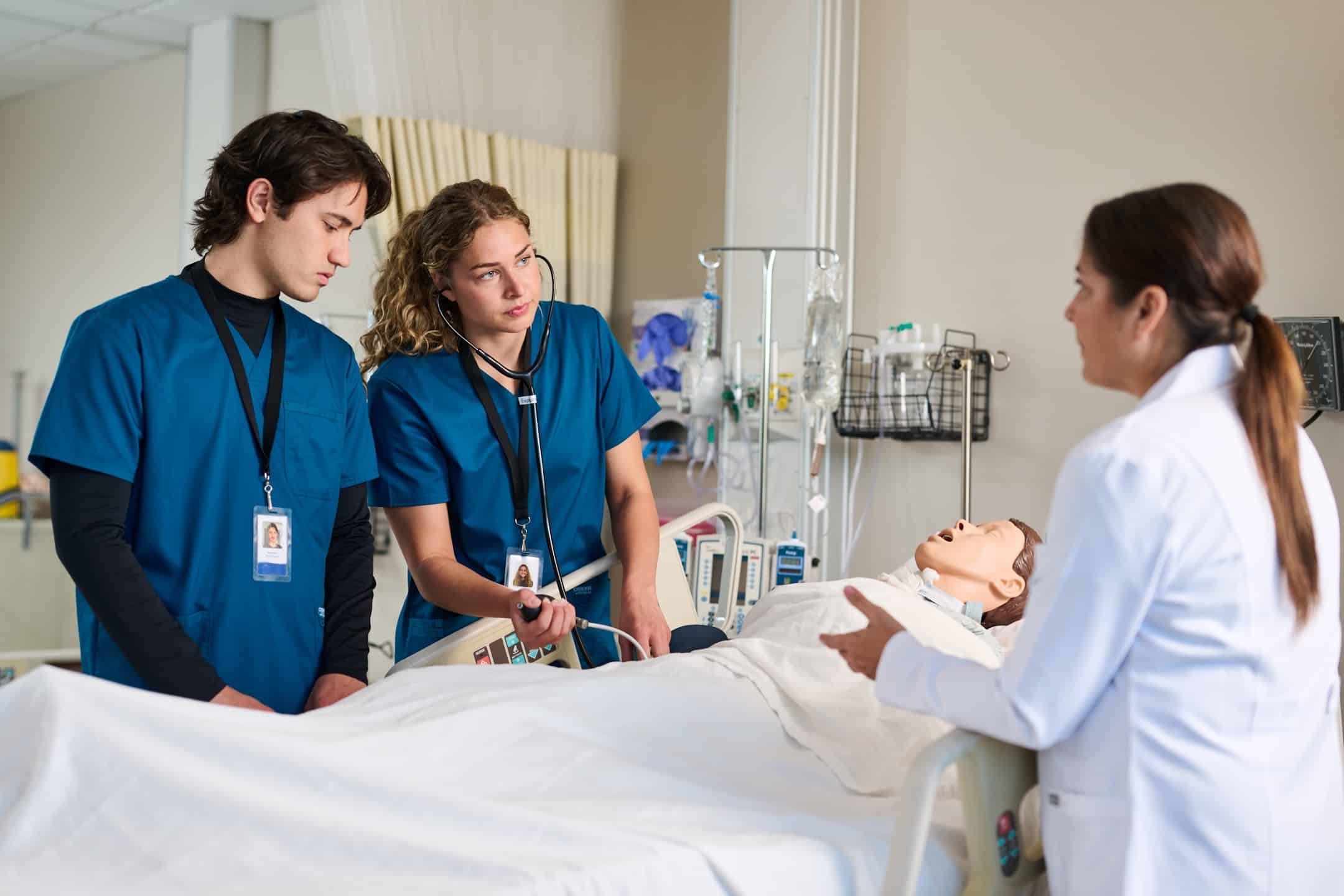
In addition to flexible online coursework, students complete structured in-person preceptorship hours in diverse healthcare and community settings, supported by on-campus skills labs, simulation, and virtual reality experiences to ensure practical application and professional growth.
20-MONTH PROGRAM
Designed for licensed RNs ready to advance without pausing their careers.
CCNE ACCREDITATION
The Bachelor of Science in Nursing Program at Unitek College of Nursing is accredited by the Commission on Collegiate Nursing Education (CCNE).
CAREER-FOCUSED TRAINING
Source RN-to-BSN graduate placement rate:
100%*
View all
Explore your campus options
Explore the RN-to-BSN options in all locations. Open a campus to see its courses and location-specific details.
California
1 campus
OnlineView detailsHide details
Study RN-to-BSN Online
Our online RN-to-BSN curriculum builds on your existing nursing experience to help you advance as a professional, evidence-based, and compassionate caregiver. Over 75 weeks, you’ll complete general education and core nursing courses that emphasize communication, leadership, and critical thinking. Through online learning, virtual simulations, and practicum experiences, you’ll gain the confidence to deliver safe, patient-centered care across today’s diverse healthcare settings.
Next start
RN to BSN Curriculum27 courses in the full curriculum120semester credits
Prerequisite General Education5 prerequisite general education courses · 17 semester credits
Course
Credits
Format
Anatomy and Physiology
6
On Campus
Anatomy and Physiology Lab
2
On Campus
Chemistry
3
On Campus
Algebra or College Math
3
On Campus
English
3
On Campus
Prerequisite General Education Total
17
General Education8 general education courses · 22 semester credits
The direct pathway prepares students for Registered Nurse licensure. In as few as three years, build a strong foundation in nursing theory, clinical judgment, and patient-centered care through immersive lab and clinical experiences.
An advancement pathway for licensed Registered Nurses ready to complete their bachelor’s degree. In as little as 20 months, strengthen leadership, communication, and evidence-based practice skills through a flexible online format designed for working professionals.
A starting point in nursing that can lead to future BSN advancement. In as little as 12 months, prepare for practical nursing licensure through a blended format that combines online coursework with hands-on clinical training.
In as little as nine months, earn your diploma through a blended learning format while gaining clinical exposure that can support future progression into nursing education and leadership.
How to Apply to the Online RN-to-BSN Program
Meet with an admissions representative virtually or in person
Provide an unencumbered Registered Nurse license
Submit a government-issued ID and proof of your high school diploma or GED
Submit official college transcripts and any proof of prerequisite programs
Complete FAFSA and financial aid appointment
Once enrolled, you are ready to start classes
By the time I finished at Unitek, I scheduled and took my NCLEX within a month. I passed on my first time, all thanks to Unitek.
Almoss M.Unitek College of Nursing Graduate
Accelerated Program
Complete your BSN in as few as 20 months through an accelerated schedule designed for working RNs who are ready to move and grow in their career.
Online Courses
Access interactive, instructor-led courses that let you learn from anywhere without putting your career on hold.
Skills Labs and Simulation Training
While most coursework is online, select learning activities may include virtual simulations and evidence-based projects that enhance your hands-on experience.
Cost and Financial Aid
We believe career advancement should be within reach. Unitek College offers financial aid options, scholarships, and payment plans for eligible students.
A Career in Registered Nursing
Registered Nurses (RNs) provide and coordinate patient care and educate patients and the public about various health conditions. They also provide advice and emotional support to patients and their families throughout treatment. Registered Nurses can find employment in a variety of healthcare settings, including hospitals, ambulatory healthcare services, nursing and residential care facilities, government settings, and educational services.
Registered nurses’ duties and responsibilities often depend on where they work as well as the patients they work with. BSN-trained nurses can pursue nursing specialties that will give them the opportunity to work with the specific patient groups that interest them the most.
According to the U.S. Bureau of Labor Statistics (BLS), as of August 2025, overall employment of Registered Nurses is expected to grow 5 percent by 2034. The source also cites an average RN salary of about $98,430 per year as of May 2024*.
Frequently Asked Questions
Tuition for the Unitek College RN-to-BSN program varies by campus location and pathway. Costs may differ based on start date, enrollment status, and whether you are entering through the RN-to-BSN completion track. Your Admissions Advisor will provide a detailed breakdown of tuition, fees, books, supplies, and other program-related expenses so you understand your total educational investment before enrolling.
Financial aid is available for those who qualify. Options may include federal grants, federal student loans, and institutional scholarship opportunities. The process begins with the Free Application for Federal Student Aid (FAFSA). After submission, the Financial Aid team will review your eligibility, explain your award package, and outline repayment responsibilities.
Yes. We offer flexible payment plans to make your nursing education more affordable and manageable. A Financial Aid representative will review your funding sources and help you structure a payment plan if needed.
Complete your FAFSA as early as possible—ideally before your program start date—to maximize your financial aid opportunities.
Yes. Official transcripts from accredited institutions are evaluated to determine which completed courses may satisfy RN-to-BSN degree requirements. Eligibility is based on course content, credit hours, and grades earned. Each transcript is reviewed individually to ensure alignment with curriculum and state requirements.
Submit your official transcripts for an evaluation. You will receive a summary outlining which credits may transfer and how they apply to your degree plan.
Credits earned at another Unitek Learning school may be transferable within the Unitek Learning network, depending on course equivalency.
The RN-to-BSN program at Unitek College is designed for licensed Registered Nurses who want to earn a Bachelor of Science in Nursing and advance professionally. This pathway recognizes prior nursing education and clinical experience, building on an ADN foundation with leadership, community health, research, and evidence-based practice.
Applicants must provide proof of RN licensure, official transcripts from an accredited nursing program, and meet program-specific admission criteria.
Yes. The RN-to-BSN program is designed for working nurses who hold a nursing diploma or other qualifying prior nursing education and want to pursue a BSN.
Fees vary by campus. Your admissions advisor will share details during the application process.
Unitek College provides students with a flexible RN-to-BSN program offered online. While the majority of coursework is completed online, the program also includes in-person preceptorship hours during the final semesters.
You can earn your BSN in as few as 20 months, depending on enrollment status and transfer credits.
Students may have access to financial counseling, academic tutoring, learning resources, resume and interview preparation, employer networking opportunities, and job placement assistance.
For an already licensed Registered Nurse, a Bachelor of Science in Nursing (BSN) is an academic advancement that strengthens leadership skills and expands knowledge in research and public health.
While you can practice as an RN with an associate degree, a BSN provides broader preparation in leadership, research, community health, and critical thinking. Some employers prefer or require BSN-prepared nurses.
The source describes supervised clinical rotations and simulation-based training in healthcare settings.
RN-to-BSN graduates may qualify for roles in hospitals, surgical centers, physician offices, public health agencies, and specialty clinics. A BSN may support career pathways in critical care, pediatrics, obstetrics, emergency nursing, perioperative nursing, community health, case management, and quality improvement.
An RN (Registered Nurse) is a professional license. A BSN (Bachelor of Science in Nursing) is an academic degree. RN refers to licensure to practice, while BSN refers to education level.
The source cites BLS projected growth of 6% for RNs from 2025 to 2035. Salaries vary by setting, experience, and location.
Earning a BSN may support advancement and higher earning potential, but compensation depends on employer, role, experience, and location.
Coursework builds on existing nursing experience with higher-level clinical decision-making and leadership content. The source also mentions advanced medical-surgical nursing, obstetrics and maternal-child health, pediatrics, mental health nursing, community health, critical care, and evidence-based practice.
The source describes nursing simulation centers, high-, mid-, and low-fidelity manikins, VR simulation technology, and hospital-style nursing skills laboratories.
The source lists Laerdal manikins, IV arms, Chester Chest central line trainers, partial-body manikins, Foley catheter insertion models, and wound care and ostomy trainers.
Fidelity refers to the sophistication of a manikin’s electronic components and ability to simulate realistic human responses, such as breathing, heart sounds, and physiological changes.
What equipment is available in Unitek College skills labs?
The source lists medical headwalls, vital-sign monitors, EKG machines, defibrillators, hospital beds, medication carts, IV supplies, and other clinical equipment.
VR simulation can help students conduct advanced patient assessments, practice medication administration, strengthen clinical reasoning, and improve communication and leadership skills.
VR allows students to experience clinical situations that may not arise during scheduled clinical rotations. It provides a safe environment to develop both technical and interpersonal skills before caring for live patients. Students receive audio, visual, and tactile feedback throughout the experience, helping reinforce learning and build confidence.
Accreditation
The baccalaureate degree program in nursing at Unitek College of Nursing is accredited by the Commission on Collegiate Nursing Education (http://www.ccneaccreditation.org).
*These placement rates are based on program-specific and campus-specific data reported to our institutional accreditor(s) in 2024. While the figures shown here are not separately reported to our accreditor, they are derived from those outcomes. For full details by program and campus, please visit our Disclosures page.
*Please note that wage data provided by the Bureau of Labor Statistics (BLS) or other third-party sources may not be an accurate reflection of all areas of the country, may not account for the employees’ years of experience, and may not reflect the wages or outlook of entry-level employees, such as graduates of our program (accessed on 10/28/2026).